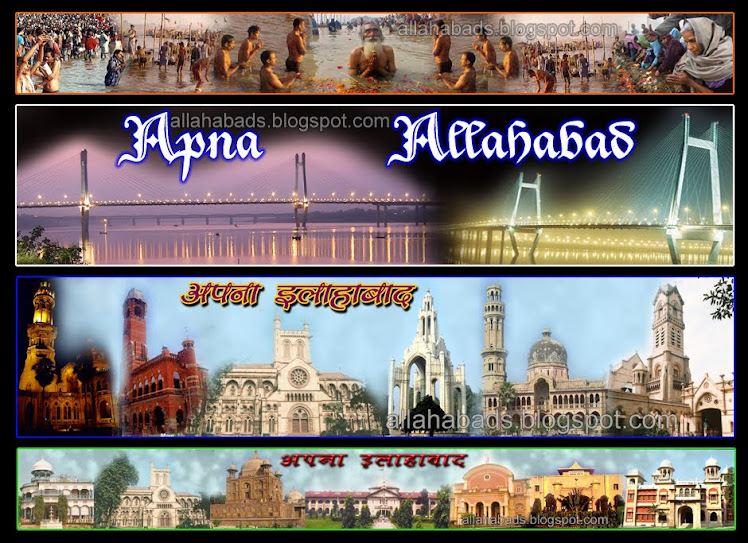
Hindus traditionally regard river confluences as auspicious places, more so the the Sangam at Allahabad, where the Yamuna and the Ganges meet the River of Enlightenment, the mythical Saraswati. According to legend, / Vishnu was carrying a Kumbh (pot) of Amrita (nectar), when a scuffle broke out between the gods, and four drops were spilled. They fell to earth at the four Tirthas of Prayag, Haridwar, Nasik and Ujjain (Tirtha means "ford of a river") a place where the devout can cross from this finite world into divine celestial realms. The event is commemorated every three years by the Kumbh Mela, held at each tirtha in turn; the Sangam is known as Tirtharaja, the "King of Tirthas", and its Mela, once every twelve years, is the greatest and holiest of all.
 The Maha Kumbh Mela - the "Great" Kumbh Mela - is the largest religious fair in India, attended by literally millions of rejoicing the vast floodplains and river banks adjacent to the confluence are overrun by pilgrims, tents, organized in almost military fashion by the government, the local authorities and the police. The mela is especially renowned for the presence of an extraordinary array of religious ascetics - sadhus and mahants - enticed from remote hideaways in forests, mountains and caves. Once astrologers have determined the propitious bathing time or Kumbhayog, the first to hit the water are legions of Naga Sadhus or Naga Babas,who cover their naked bodies with ash, and wear hair in long dreadlocks. The sadhus, who see themselves as guardians of the faith, approach the confluence at the appointed time with all the pomp and bravado of a charging army. The next Maha Kumbh Mela is due to take place in 2013.
The Maha Kumbh Mela - the "Great" Kumbh Mela - is the largest religious fair in India, attended by literally millions of rejoicing the vast floodplains and river banks adjacent to the confluence are overrun by pilgrims, tents, organized in almost military fashion by the government, the local authorities and the police. The mela is especially renowned for the presence of an extraordinary array of religious ascetics - sadhus and mahants - enticed from remote hideaways in forests, mountains and caves. Once astrologers have determined the propitious bathing time or Kumbhayog, the first to hit the water are legions of Naga Sadhus or Naga Babas,who cover their naked bodies with ash, and wear hair in long dreadlocks. The sadhus, who see themselves as guardians of the faith, approach the confluence at the appointed time with all the pomp and bravado of a charging army. The next Maha Kumbh Mela is due to take place in 2013.

